
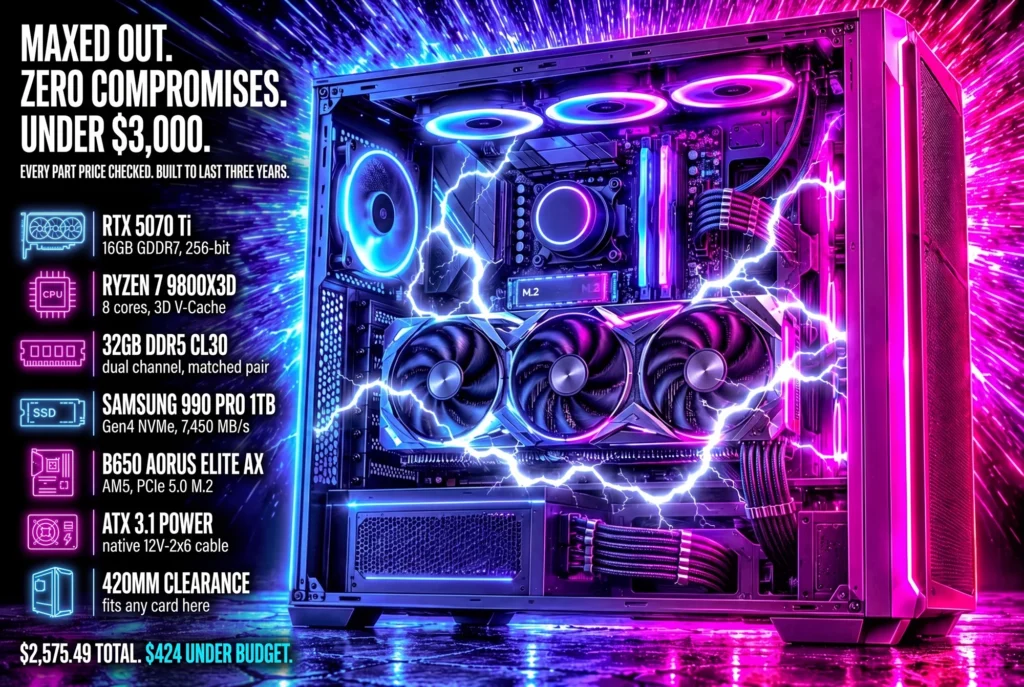
Eight parts, $2,577.99 total, and one line item that says everything about building in 2026: the memory costs $75.00 more than the processor.
- Total: $2,577.99. Against a $3,000 ceiling, so a single price move does not break the list.
- This is the first of our three builds that can afford 32GB in dual channel. The $2,000 machine could not.
- 1TB, not 2TB. A deliberate trade, and we show you exactly what it bought.
- The cooler is 1 percent of the build and it is the one our $2,000 machine names as its first upgrade.
This high end gaming PC build costs $2,577.99 and it is the machine our other two build guides keep pointing at. It is a 1440p and entry-4K system built around an RTX 5070 Ti and a Ryzen 7 9800X3D, and it is the first budget at which the memory question that shaped both cheaper builds finally stops being a compromise.
That question is worth stating plainly, because it is the single most useful thing on this page. Our $1,000 build runs 16GB of DDR4 as a matched pair for $99.97. Our $2,000 build runs 16GB of DDR5 as a single stick, because a matched pair cost more than the graphics card upgrade it would have displaced. This build runs 32GB of DDR5 in dual channel at CL30, and it pays $489.99 for the privilege, which is 4.9 times what the $1,000 machine spends on memory for twice the capacity.
Every price below was checked against Amazon on August 14, 2026. There are 27,413 ratings behind these eight parts. Where we made a trade, we say what it cost.
The full parts list
| Part | Component | Key spec | Price | Rating | Share |
|---|---|---|---|---|---|
| Graphics card | GIGABYTE RTX 5070 Ti Gaming OC | 16GB GDDR7, 256-bit | $1,249.99 | 4.5 (695) | 42% |
| Memory | TEAMGROUP T-FORCE DELTA RGB | 32GB (2×16) 6000 CL30 | $509.99 | 4.7 (1,472) | 20% |
| Processor | AMD Ryzen 7 9800X3D | 8-core, 16-thread | $444.99 | 4.8 (6,086) | 17% |
| Storage | Samsung 990 PRO 1TB | PCIe 4.0, 7,450 MB/s | $239.99 | 4.7 (13,314) | 10% |
| Motherboard | GIGABYTE B650 AORUS Elite AX | AM5, 14+2+1 phases | $149.99 | 4.3 (1,548) | 6% |
| Power supply | CORSAIR RM750e | 750W, ATX 3.1, modular | $89.99 | 4.6 (395) | 4% |
| Case | MONTECH XR Panoramic | 420mm GPU, 3 ARGB fans | $69.90 | 4.8 (764) | 3% |
| CPU cooler | Thermalright Peerless Assassin 120 SE | 6 heat pipes, dual fan | $31.41 | 4.7 (3,264) | 1% |

| Memory | 16GB GDDR7 |
| Bus | 256-bit |
| Cooling | WINDFORCE triple fan |
| Rating | 4.5 (695) |

| Capacity | 32GB (2×16) |
| Speed | 6000MHz CL30 |
| Profiles | EXPO and XMP 3.0 |
| Rating | 4.7 (1,472) |
| Cores | 8, 16 threads |
| Socket | AM5 |
| Cache | 3D V-Cache |
| Rating | 4.8 (6,086) |

| Capacity | 1TB |
| Interface | PCIe 4.0 x4 |
| Read | 7,450 MB/s |
| Rating | 4.7 (13,314) |
| Socket | AM5 |
| Form | ATX |
| Network | WiFi 6E, 2.5Gb |
| Rating | 4.3 (1,548) |

| Capacity | 750W |
| Standard | ATX 3.1 |
| Cable | 12V-2×6 included |
| Rating | 4.6 (395) |

| GPU | Up to 420mm |
| Fans | 3 ARGB PWM |
| Radiator | 360mm |
| Rating | 4.8 (764) |

| Type | Dual tower air |
| Heat pipes | 6 |
| Fans | 2 x 120mm PWM |
| Rating | 4.7 (3,264) |
The graphics card: GIGABYTE RTX 5070 Ti Gaming OC
- Powered by the NVIDIA Blackwell architecture and DLSS 4
- Powered by GeForce RTX 5070 Ti
- Integrated with 16GB GDDR7 256bit memory interface
Forty-two percent of the budget, which is where it belongs. 16GB of GDDR7 on a 256-bit bus is the specification that makes this a 1440p card with genuine 4K capability rather than a 1440p card that struggles above it, and 16GB of video memory means it will not be the first thing to age out.
At $1,249.99 this is the RTX 5070 Ti we would buy, and the reason is evidence as much as price: 679 owner ratings at 4.5 stars, sold by Amazon directly. Cheaper 5070 Ti listings exist and we checked them; the ones materially below this price were shipping through third-party sellers with no Prime delivery, which is a different product to buy even when the box is identical.
The WINDFORCE cooler is a triple-fan design, so clearance matters. The MONTECH case below takes cards up to 420mm and clears it comfortably. If you would rather compare the alternatives, they are in our graphics card guide.
- 16GB of GDDR7 on a 256-bit bus, which ages well
- 679 ratings at 4.5, the deepest sample of any 5070 Ti we checked
- Sold by Amazon directly rather than a marketplace seller
- Triple-fan cooler, and the case below clears it comfortably
- The single largest line item by a wide margin
- Triple-fan cards are long, so clearance has to be checked
- The 5070 Ti is a 1440p card first and a 4K card second
The memory: TEAMGROUP T-FORCE DELTA RGB 32GB CL30
- Ddr5 supports Intel Xmp 3.0 for one-click overclocking. Compatible with Intel 600 & 700 series chipset.
- Rgb colors & 120° ultra-wide lighting. Equipped with smart Rgb ic controller that supports various lighting effect softw…
- Power management ics (pmics) equipped for efficient power usage.
$489.99 for 32GB. Twenty percent of the build. Seventy-five dollars more than the processor. This is the single line item that separates 2026 from every previous year of PC building, and it is the reason our $2,000 machine runs one memory stick instead of two.
What the money buys here is worth being precise about: 32GB in a matched pair at 6000MHz CL30, with both AMD EXPO and Intel XMP 3.0 profiles. The CL30 part matters and it is not marketing. Our RAM guide makes the case that CL30 at 6000MHz is meaningfully quicker than CL36 at the same speed, and we found a CL36 kit twenty dollars cheaper. We did not take it, because recommending against our own guide to save $20.00 on a $2,577.99 machine would be indefensible.
Two sticks rather than one is the other half of it. Dual channel is not a luxury feature, it is how the memory controller is designed to be used, and the $2,000 build gives up real frame rates by running single channel.
- 32GB in dual channel, the first of our builds that can afford it
- CL30 at 6000MHz, matching what our RAM guide actually recommends
- Both EXPO and XMP 3.0, so it works on AMD or Intel
- 1,479 ratings at 4.7 stars
- $489.99 is more than the processor costs, which is absurd and unavoidable
- Twenty percent of the total budget for one component
- RGB memory can conflict with large air coolers, though not this one
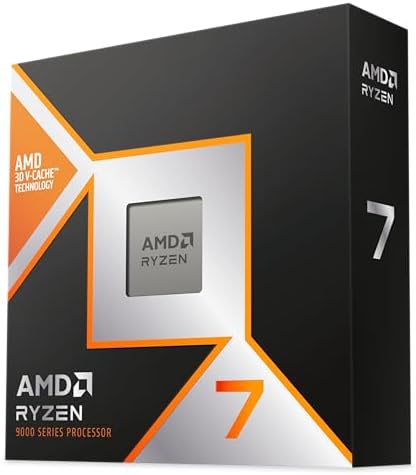
The processor: AMD Ryzen 7 9800X3D
- The world’s fastest gaming processor, built on AMD ‘Zen5’ technology and Next Gen 3D V-Cache.
- 8 cores and 16 threads, delivering +~16% IPC uplift and great power efficiency
- 96MB L3 cache with better thermal performance vs. previous gen and allowing higher clock speeds, up to 5.2GHz
Eight cores, sixteen threads, 4.8 stars from 6,028 ratings, and the stacked cache that makes X3D chips the ones gamers actually want. It is not AMD’s fastest processor and that is the point: for games specifically, the cache matters more than core count, and the sixteen-core parts cost $70.00 to $184.01 more while gaming no better.
It sits on AM5, which unlike the AM4 socket in our $1,000 build has processor generations still ahead of it. That is a large part of what this budget is buying: a platform you can upgrade rather than replace.
One practical note. X3D processors do not ship with a cooler, so the $34.90 line at the bottom of this list is not optional.
- 6,028 ratings at 4.8 stars, an unusually settled question
- 3D V-Cache is the single best feature a gaming processor can have
- AM5 has upgrade path left, unlike AM4
- Cheaper than AMD’s higher core-count parts that game no better
- No cooler in the box, so budget for one
- Eight cores is fewer than some workstation tasks want
- $414.99 is a lot for a processor, though less than this build’s memory
The storage: Samsung 990 PRO 1TB
- HUGE SPEED BOOST: Get random read/write speeds that are 40%/55% faster than 980 PRO; Experience up to 1400K/1550K IOPS, …
- BREAKTHROUGH POWER EFFICIENCY: Use less power and get more performance; Enjoy up to 50% improved performance per watt ov…
- SMART THERMAL CONTROL: Samsung’s own nickel-coated controller delivers effective thermal control; With its slim size, 99…
PCIe 4.0, up to 7,450 MB/s, and 13,315 ratings at 4.8 stars, which is the largest sample of any part in this build. The 990 PRO is the drive other drives get compared against.
It is 1TB, and that is the trade we made. We explain it in full below, but the short version is that a 2TB NVMe drive of this class costs $339.99 or more right now, and the extra $100.00 went into the memory instead.
- 13,315 ratings at 4.8 stars, near-total confidence
- 7,450 MB/s read, at the top of what PCIe 4.0 offers
- Samsung’s controller and firmware are the reference point
- The motherboard below has spare M.2 slots for expansion
- 1TB fills fast: six or seven current titles plus Windows
- 2TB of the same drive costs $150.00 more
- PCIe 4.0 rather than Gen5, though Gen5 changes nothing in games
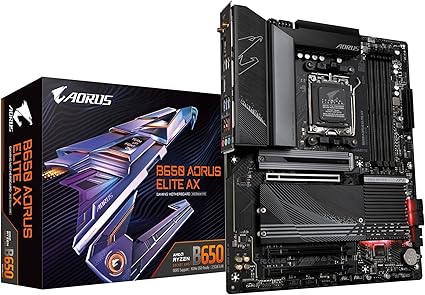
The motherboard: GIGABYTE B650 AORUS Elite AX

- AMD Socket AM5: Supports AMD Ryzen 9000/Ryzen 8000/Ryzen 7000 Series Processors
- DDR5 Compatible: 4*DIMMs with AMD EXPO & Intel XMP Memory Module Support
- Commanding Power Design: Twin 14+2+1 Phases with 70A Power Stage Digital VRM Solution, 8-Layer 2X Copper PCB
Six percent of the build, 1,557 ratings, and a 14+2+1 power phase design, which is the specification that actually matters when you are feeding an X3D processor. It has PCIe 5.0 M.2, DDR5, WiFi 6E and 2.5 Gb Ethernet.
B650 rather than X870 is deliberate. The premium chipsets add PCIe lanes and connectivity that a single graphics card and a single drive will never use, and that money is better spent on the memory. Our motherboard guide makes the same argument at every budget: buy the chipset your parts need, not the one at the top of the range.
- 14+2+1 power phases, ample for a 9800X3D
- 1,557 ratings, a deep sample for an AM5 board at this price
- WiFi 6E, 2.5 Gb Ethernet and PCIe 5.0 M.2 included
- Spare M.2 slot for the storage upgrade you will eventually want
- 4.3 stars is the lowest rating in this build
- B650 gives up some PCIe lanes against X670 or X870
- ATX, so it needs a full-size case
The power supply: CORSAIR RM750e
- Fully Modular PSU: Reliable and efficient, low-noise power supply with fully modular cabling, so you only have to connec…
- Intel ATX 3.1 Certified: Compliant with the ATX 3.1 power standard, supporting PCIe 5.1 platform withstands 2x transient…
- Keeps Quiet: A 120mm rifle bearing fan with a specially calculated fan curve keeps fan noise down, even when operating a…
This is the top pick from our power supply guide and it is here for the reason that guide gives: it is ATX 3.1, fully modular, and the 12V-2×6 cable is in the box rather than sold separately.
Seven hundred and fifty watts will look low to anyone who assumes an expensive build needs a four-figure power supply. It does not. Size the unit from the graphics card, and a 5070 Ti does not ask for more than this. Buying 1000W here would have cost $25.00 more and delivered nothing except a unit running further from its efficient load point.
- Our overall pick in a guide covering eight power supplies
- 12V-2×6 cable included, not an adapter
- Fully modular, so only the cables you need go in the case
- 105 degree C rated capacitors
- 750W leaves less headroom if you later fit a much larger card
- Cybenetics Gold rather than 80 Plus Gold, which buyers conflate
- 355 ratings is moderate next to the rest of this build
The case: MONTECH XR Panoramic
- Experience mature wood grain design I/O interface, seamlessly blending nature’s charm into your workspace while providin…
- Accommodates a 360mm radiator at the top and supports high-end GPUs like the 40 series.
- Despite its compact size, XR boasts exceptional compatibility, ensuring it meets all your high-performance gaming needs.
Three percent of the budget for the highest-rated case in our case guide, at 4.8 stars from 753 ratings. Three ARGB PWM fans are included, it takes a 360mm radiator, and it has USB-C and magnetic dust filters.
The specific reason it is here rather than a prettier case is 420mm of graphics card clearance, published in the listing. It is the only case among our eight picks that states the figure at all, and with a triple-fan 5070 Ti going in, guessing is not an option.
- Publishes 420mm GPU clearance, which nothing else in our guide does
- 4.8 stars from 753 ratings, the best in our case guide
- Three ARGB PWM fans included at $69.90
- Magnetic dust filters and USB-C front I/O
- Three fans in a chassis that holds nine, so add more if you want
- Panoramic glass restricts intake slightly against a mesh front
- MONTECH is a smaller brand than NZXT or Corsair
The cooler: Thermalright Peerless Assassin 120 SE
- [Brand Overview] Thermalright is a Taiwan brand with more than 20 years of development. It has a certain popularity in t…
- [Product specification] Thermalright PA120 SE; CPU Cooler dimensions: 125(L)x135(W)x155(H)mm (4.92×5.31×6.1 inch); heat …
- 【2 PWM Fans】TL-C12C; Standard size PWM fan:120x120x25mm (4.72×4.72×0.98 inches); fan speed (RPM):1550rpm±10%; power port…
One percent of a $2,577.99 machine. Six heat pipes, two 120mm PWM fans, 3,247 ratings at 4.7 stars, and it is the best-value pick in our CPU cooler guide at $34.90.
We could have fitted the Noctua NH-D15 chromax.Black, which is the highest-rated cooler in our guide and holds 4.8 stars across 13,514 ratings. At $119.95 it costs $85.05 more, and this budget would have absorbed that comfortably. We left it out anyway, because an 8-core X3D processor is not a thermal problem, and paying roughly three and a half times as much to cool it would be spending for the sake of the price tier rather than the machine.
This is the same cooler our $2,000 build names as the first upgrade it would make. That is not an oversight, it is the finding: cooling is the one component that does not scale with budget.
- 3,247 ratings at 4.7 stars for $34.90
- Six heat pipes and dual fans, genuinely competitive with far dearer coolers
- Lists AM5 explicitly, along with current Intel sockets
- Leaves $85.05 in the budget for parts that benefit more
- A large dual tower, so check clearance against tall memory
- Mounting hardware is fiddlier than premium brands
- No lighting, on a build with an RGB memory kit and ARGB fans
Where the money goes
The memory costs more than the processor
$489.99 against $414.99. A difference of $75.00, in favor of the memory. If you have not bought PC parts in a couple of years, that sentence should stop you, because it inverts the order things have been in for as long as most people have been building.
It is not a quirk of this particular kit. The cheapest 32GB DDR5 kits our searches returned were $469.99, and they ran to $619.99. There is no configuration of this build at this budget where memory is a minor line item.
What it means practically is that memory is now a tier decision rather than a checkbox. At $1,000 you take DDR4 and get dual channel cheaply. At $2,000 you are forced to choose between 32GB of system memory and 16GB of video memory, and our $2,000 build chose the video memory and ran a single stick. At $3,000 the choice finally goes away. That is most of what the extra $780.06 over the $2,000 machine actually buys.
Why 1TB and not 2TB
This is the trade we made and we would rather explain it than hide it. A Samsung 990 PRO in 2TB costs $150.00 more than the 1TB we specified, and other 2TB drives of similar class start around $339.99.
Spending that would have meant either dropping to a CL36 memory kit, which contradicts our own storage and memory guidance, or taking a cheaper graphics card. Neither is a good trade, because storage is the one component in this list you can add to later without replacing anything. The motherboard has spare M.2 slots. Memory and graphics do not work that way.
Be clear-eyed about what 1TB means though. A single large title can occupy 150GB, so with Windows installed you are realistically holding six or seven of them. If you keep a big library installed, buy the 2TB drive and take the money from somewhere else, or add a second drive in six months.
How it compares to our $2,000 and $1,000 builds
The three machines now form a straight line, and the memory column is the interesting one.
| Build | Total | Memory | Graphics | Target |
|---|---|---|---|---|
| $1,000 build | $846.90 | 16GB DDR4 dual channel, $99.97 | RTX 3050 6GB | 1080p |
| $2,000 build | $1,797.93 | 16GB DDR5 single stick, $224.99 | RTX 5060 Ti 16GB | 1440p |
| This build | $2,577.99 | 32GB DDR5 dual channel CL30, $489.99 | RTX 5070 Ti 16GB | 1440p and entry 4K |
Note the middle row. The $2,000 machine is the only one of the three running single-channel memory, and it is not because we were careless with it. At that budget a matched DDR5 pair costs more than the difference between two graphics card tiers, so it loses memory bandwidth to keep 16GB of video memory. The $1,000 machine avoids the problem entirely by using DDR4, where a matched pair is $99.97.
This build is the first point at which you stop choosing. That, rather than raw frame rate, is the honest argument for spending $2,577.99 instead of $1,797.93.
What we would upgrade first
1. A second storage drive, when 1TB fills. It will. The board has spare M.2 slots and this is the cheapest meaningful upgrade available to this machine.
2. Nothing else, for about three years. That is the actual answer and it is unusual for us to give it. The graphics card has 16GB of video memory, the processor is the best gaming chip AMD makes on a socket with generations left, the memory is 32GB in dual channel, and the power supply is ATX 3.1 with the modern connector. There is no obvious weak link to fix.
3. When the time comes, the graphics card. The RM750e handles a step up, the case clears 420mm, and AM5 will still be taking new processors. This build was assembled so that the first real upgrade is a long way off.
How we chose these parts
Every component was pulled from live Amazon search results, then validated individually against the retailer page for price, rating, review count and availability on August 14, 2026. All eight validated clean, which is not something we can say about every guide we have written this month.
Each part is also the pick, or a named alternative, from the corresponding guide on this site: graphics cards, processors, memory, storage, motherboards, power supplies, cases and coolers. Where this build departs from a guide’s top pick, the reason is stated on this page rather than left for you to find.
One process note, since the number invites the question. The parts here were chosen first and priced second. The list comes to $2,577.99 against a $3,000 ceiling, and that gap is deliberate. An earlier version of this build was written to a tighter cap, came in twenty cents under it, and a single price move broke it. A parts list that only works to the cent is a snapshot rather than a recommendation, so the ceiling now sits far enough above the total to absorb ordinary price drift. The MONTECH case stays for the reasons it was chosen: it is the higher-rated case and the only one that publishes graphics card clearance. If you are pairing this with a display, our monitor guide covers what to put in front of it, and that is a separate budget.
Frequently asked questions
Can you build a high end gaming PC for under $3,000 in 2026?
Yes. This parts list comes to $2,577.99 as verified on August 14, 2026: a Ryzen 7 9800X3D, an RTX 5070 Ti 16GB, 32GB of dual-channel DDR5 at CL30, a 1TB Samsung 990 PRO, a B650 board, a 750W ATX 3.1 supply, a case and a cooler. It targets 1440p at high refresh with genuine 4K capability.
Why does the memory cost more than the processor?
Because DDR5 pricing in 2026 is extraordinary. The memory kit is $489.99 and the Ryzen 7 9800X3D is $414.99, a difference of $75.00. The cheapest 32GB DDR5 kits we found were $469.99 and they ran to $619.99. There is no version of this build where memory is a minor line item.
Is 32GB of RAM necessary for gaming?
For gaming alone, 16GB in dual channel is still adequate. 32GB matters if you multitask heavily, stream, or work with large files alongside games. At this budget it is worth having, and more importantly it lets you run a matched pair rather than the single stick our $2,000 build is forced into.
Why only 1TB of storage on a $3,000 build?
Because a 2TB drive of this class costs $150.00 more, and storage is the one component you can add later without replacing anything. The motherboard has spare M.2 slots. Memory and graphics cards do not work that way, so the money went there instead. If you keep a large library installed, buy 2TB.
Is the Ryzen 7 9800X3D better than a 16-core processor for gaming?
For games, yes. The stacked 3D V-Cache matters more than core count in almost every title, and AMD’s 16-core parts cost between $70.00 and $184.01 more while gaming no better. Core count matters for rendering and compilation, not for frame rates.
Is 750W enough power for an RTX 5070 Ti?
Yes. Size a power supply from the graphics card, not from the price of the build. A 5070 Ti does not ask for more than 750W with an 8-core processor, and a 1000W unit would have cost $25.00 more while running further from its efficient load point. The unit here is ATX 3.1 with the 12V-2×6 cable included.
Why is the cooler only $34.90 on a $3,000 build?
Because cooling is the one component that does not scale with budget. An 8-core X3D processor is not a thermal problem, and the Thermalright Peerless Assassin 120 SE holds 4.7 stars across 3,247 ratings. The Noctua NH-D15 chromax.Black costs $85.05 more at $119.95, and the budget would have covered it, but an 8-core X3D processor is not a thermal problem, so the money buys nothing here.
Will this build handle 4K gaming?
At entry level, yes. The RTX 5070 Ti with 16GB of GDDR7 on a 256-bit bus is a 1440p card first and a capable 4K card second. Expect high refresh at 1440p and playable 4K with upscaling in demanding titles. If 4K at high refresh is the goal, the graphics card is where the extra money has to go.
Is it worth spending $3,000 instead of $2,000 on a gaming PC?
The difference is $780.06, and most of it buys the end of the memory compromise. Our $2,000 build runs a single 16GB DDR5 stick because a matched pair costs more than two graphics card tiers apart. This machine runs 32GB in dual channel at CL30, on a faster card, with the same upgrade path. Whether that is worth about nine hundred dollars depends on what you play and at what resolution.
The bottom line
This high end gaming PC build costs $2,577.99, has 27,413 ratings behind its eight parts, and is built for 1440p at high refresh with genuine 4K capability. Every price was verified on August 14, 2026 and every compatibility question is worked through above rather than assumed.
The thing to understand before you order is what the money actually bought. Forty percent went to the graphics card, which is normal. Twenty percent went to memory, which is not, and that single line is the difference between this machine and our $2,000 one. You are not buying a faster processor or a bigger drive at this tier. You are buying the end of the memory compromise.
And the advice that holds at every budget: put the money in the graphics card, buy the socket with a future, never economize on the power supply, and do not spend four times as much on a cooler as the job requires. If you would rather not assemble it yourself, our prebuilt gaming PC guide covers that route.
Prices and ratings on this page update automatically and were last refreshed on August 26, 2026. Every other figure was accurate on August 14, 2026 and carries no guarantee beyond that. Component prices move quickly, and memory prices are moving faster than most. Check each one before you buy.
Nothing portable in our laptop guide comes close to this, which is worth knowing if you are weighing one. The most expensive machine in our gaming laptop guide is $1,999.99, and it carries the laptop version of this same RTX 5070 Ti. That is not the same part: mobile cards run to far lower power limits than their desktop namesakes, so the name matches and the performance does not. Buy a laptop for portability, never for performance per dollar.
At this budget the parts choice matters most, which is the case for building. Our guide to prebuilt vs building your own PC explains where prebuilt makers cut costs and why it shows up years later.
Wondering whether the X3D premium belongs in this build? Our X3D vs non-X3D explainer works through when it pays and when the money does more good in the graphics card.
Gamers Tech Guide participates in the Amazon Services LLC Associates Program. As an Amazon Associate we earn from qualifying purchases.